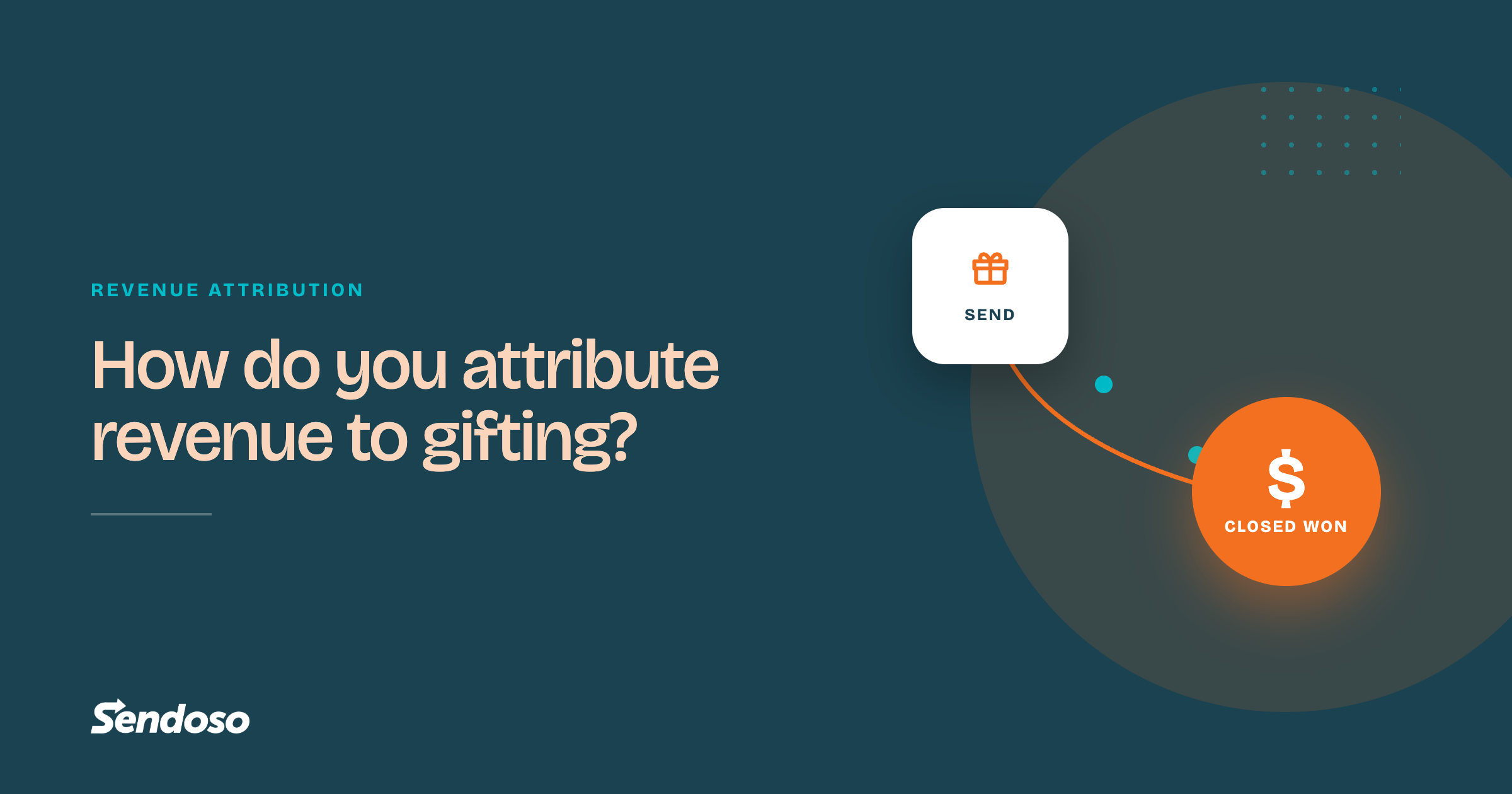
How do you measure ROI from corporate gifting?
.avif)

Gifting programs look measurable until you try to measure them.
We said what we said.
You have send data.
You have some closed deals.
But connecting those two things in a way that survives a CFO question is harder than it looks - especially when you haven't counted admin time, undelivered packages, or the 240 person-hours Forrester documented teams burning through per campaign just on logistics.
Most teams bring finance a number built on gift spend alone. Finance finds the holes. The program loses budget.
The framework below changes that. It covers the full cost stack, how to set a baseline before a campaign launches, and how to use CRM tagging and holdout groups to build attribution that doesn't fall apart under scrutiny.
What is corporate gifting ROI?
Corporate gifting ROI is the ratio of revenue impact to total program cost. Revenue impact covers three things:
- Pipeline sourced: New opportunities where a gift was the first meaningful touchpoint that triggered a response
- Pipeline influenced: Deals already in motion that moved faster or closed because of a gift
- Revenue retained: Renewals and expansions tied to gifting touchpoints during the customer lifecycle
Most teams only count gift spend when calculating cost. They ignore the hours spent sourcing, coordinating, and tracking sends, and they don't account for the packages that get returned due to bad addresses. Undercount cost and you inflate ROI. Finance will catch it.
What formula measures corporate gifting ROI?
ROI = (Revenue Impact - Total Program Cost) / Total Program Cost x 100
Revenue impact and total program cost each have components most teams miss. The sections below break those down so you can calculate a number that survives scrutiny.
What costs should you include?
Most teams count the gift and stop there. The full cost stack includes:
- Gift spend: Unit cost of the gift, including customization
- Fulfillment and shipping: Packing, postage, international duties
- Platform or vendor fees: Any SaaS subscription or per-send fee
- Admin time: Hours spent sourcing, coordinating, and tracking sends, converted to dollars using the sender's fully-loaded hourly rate
- Waste and undelivered sends: Gifts that were never claimed or returned
Admin time is the hidden cost most teams miss entirely. Forrester's Total Economic Impact study of Sendoso documented that manual gifting processes consumed two full work-weeks of three marketing coordinators' time per campaign, 240 person-hours just to plan, pack, track, and ship. Waste is the other silent budget killer: the same study found that 10% of bulk direct-mail packages were returned due to address errors before teams implemented address confirmation.
What revenue should you count?
Decide whether you're claiming sourced or influenced pipeline before you run the math. Mixing them produces a number nobody trusts.
- Sourced pipeline: Opportunities where a gift was the first touch that triggered a response
- Influenced pipeline: Opportunities already in motion where a gift accelerated a stage, like a stalled deal that moved to proposal after a send
- Retained revenue: Renewals or expansions from accounts that received gifting touchpoints
Influenced pipeline is harder to defend because other touches were also in play. Be honest about that with finance. A conservative, defensible number beats an inflated one that gets challenged.
What does a simple ROI example look like?
A demand gen team runs a gifting campaign targeting 500 stalled opportunities. The full cost stack breaks down as:
- $15,000 in gift spend
- $3,000 in fulfillment and shipping
- $2,000 in platform fees
- $4,000 in admin time (80 hours at $50/hour fully-loaded rate)
- Total cost: $24,000
The campaign generates 75 responses, 40 booked meetings, and 8 closed deals worth $120,000 in new revenue. Using the formula: ($120,000 - $24,000) / $24,000 x 100 = 400% ROI. The math is straightforward once you have the full cost stack and a clear definition of what revenue you're counting.
Which gifting metrics matter most?
The formula gives you the headline number, but the metrics below are what you track during a campaign to know whether you're on track. They split into two categories: leading indicators, which tell you a campaign is working before revenue lands, and lagging indicators, which confirm it worked after the fact.
Which pipeline metrics show revenue impact?
These are the metrics finance cares about most.
- Response rate: The percentage of gift recipients who replied, booked a meeting, or took the desired next action
- Meeting conversion rate: Of recipients who responded, how many converted to a booked meeting
- Pipeline sourced per campaign: Total new opportunity value created where a gift was the first touch
- Pipeline influenced per campaign: Total opportunity value where a gift was a contributing touch
- Deal velocity: Average days to close for gifted accounts vs. non-gifted accounts in the same segment
- Win rate: Close rate for gifted opportunities vs. a control group
Forrester's Total Economic Impact study documented meeting acceptance rates improving from 58% to 85-93% and opportunity-to-deal close rates doubling from 10% to 20-25% after teams integrated sending touchpoints into their sales motions. One interviewed company reported a 15% drop in average sales cycle length.
Which customer metrics show retention impact?
These matter most for CX and CS teams running gifting programs post-sale. The comparison only works if you're tracking gifted and non-gifted cohorts separately from the start. Retroactive analysis introduces too many variables to produce a defensible claim.
- Renewal rate (gifted vs. non-gifted accounts): The clearest signal that gifting influences retention
- Expansion revenue: Upsell and cross-sell revenue from accounts that received gifting touchpoints
- Churn rate by cohort: Compare churn in accounts that received gifts against those that didn't, controlling for segment and contract value
Which engagement metrics show recipient interest?
These are leading indicators that tell you a campaign is resonating before pipeline data matures.
- Redemption rate: The percentage of gift offers actually claimed by recipients. A low redemption rate signals the offer, message, or timing missed the mark.
- Claim velocity: How quickly recipients claimed the gift after receiving the offer link. Faster claims suggest stronger relevance.
- Cost per send: Total campaign cost divided by number of gifts sent, a useful efficiency benchmark across campaigns
The ANA Response Rate Report 2023 found that direct mail to house files generated a 15.6% response rate, while prospect files generated 10.8%. Those benchmarks give you a reality check on whether your gifting campaigns are performing above or below channel norms.
Which operations metrics protect margin?
These are the metrics most teams ignore, and they're the ones that quietly destroy ROI.
- Delivery success rate: The percentage of sends that reached the recipient without a failed address or return
- Undelivered and unclaimed rate: Gifts sent but never received or claimed, pure cost with zero revenue impact
- Waste as a percentage of total spend: Especially relevant for teams holding physical inventory, where unsent stock is a hidden cost
The USPS Office of Inspector General reported that 4.3% of all mail volume was undeliverable-as-addressed, costing the mailing industry roughly $20 billion annually to handle. Every returned package is a double cost: you paid to send it, and now you're paying to handle the return.
How do you connect gifting to revenue?
Having the right metrics means nothing if you can't tie gift activity to revenue outcomes in your CRM. The four steps below are a process, not a menu of options. Skip one and your attribution breaks.
How do you set the baseline?
Before launching any gifting campaign, capture the current state of the metrics you plan to move. Without a baseline, you can't prove lift. Pull and record the following before the campaign launches:
- Current response rate for the target account segment
- Average deal velocity for open opportunities in that segment
- Renewal rate for the customer cohort being targeted
- Current win rate for comparable opportunities
These numbers become your control. If your gifting campaign produces a 12% response rate but your baseline was already 11%, you didn't move the needle.
How do you tag gift activity in your CRM?
If a gift send isn't logged in the CRM against the contact and opportunity record, it doesn't exist for attribution purposes. Every send needs to be recorded as an activity against the contact record, including send date, gift type, and campaign name, with a custom field (e.g., "Received Gift: Yes/No + Date") to enable filtered reporting.
Manual logging creates gaps. Sendoso integrates directly with Salesforce, HubSpot, and other CRM and marketing platforms to automate this sync, so gift activity is captured without manual logging, written as a touchpoint the same way an email open or webinar attendance would be recorded.
How do you compare gifted accounts to holdouts?
A holdout group is a randomly selected portion of the target list that does not receive a gift, used as a control to isolate the effect of gifting from other variables. Without one, you can't separate gifting's contribution from a strong sales motion, a product update, or a seasonal buying cycle.
Randomly assign accounts to gifted and non-gifted groups before the campaign starts, keep all other outreach identical between the two groups, then compare response rate, deal velocity, and win rate at the end of the campaign window. Holdout groups feel counterintuitive to sales teams ("why would we not send a gift to a hot account?"). The proof they generate makes the next budget cycle easier. A 5% lift in win rate backed by a clean control group is more credible than a 20% lift with no comparison data.
Which attribution model should you use?
Attribution models determine how much credit gifting gets when multiple touches are in play.
- First-touch attribution: Gifts get full credit if they were the first interaction that generated a response. Best for demand generation campaigns targeting cold accounts.
- Last-touch attribution: Gifts get full credit if they were the final touch before a deal closed. This overstates gifting's role in complex B2B sales cycles and is not recommended.
- Multi-touch attribution: Credit is distributed across all touches in the buying journey. More accurate for long sales cycles, though it requires CRM data discipline to implement.
In B2B gifting programs with long sales cycles, multi-touch attribution with a conservative estimate of gifting's share is the right call. It's harder to challenge than first- or last-touch claims, and it survives a CFO review.
How do you prove ROI to leadership?
You've done the measurement work. Now you need to present it in a way that moves a budget decision. The internal selling problem is just as hard as the measurement problem.
What should your dashboard show?
A one-page dashboard shows the gifting program's performance at a glance. If it requires explanation to read, it won't survive a leadership review. Include:
- Spend to date: Total program cost, broken down by gift spend, fulfillment, and platform fees
- Pipeline sourced: New opportunity value where gifting was the first touch
- Pipeline influenced: Opportunity value where gifting was a contributing touch, with the attribution methodology noted
- Response rate vs. baseline: Current campaign response rate compared to the pre-campaign baseline
- Deal velocity: Average days to close for gifted vs. non-gifted accounts
- Win rate: Close rate for gifted vs. non-gifted opportunities
- Top-performing sends: Which gift types and campaigns generated the highest response and conversion rates
Sendoso's Oso AI agent surfaces this kind of program performance data on demand, answering natural-language questions about top campaigns, spend by team, and engagement rates without requiring manual exports or dashboard builds.
What story should finance hear?
Finance wants to hear one thing: for every dollar spent on gifting, here's what came back. Start with total program cost (the full cost stack, not just gift spend), state the pipeline sourced or influenced with the attribution methodology acknowledged, calculate the ROI percentage, then add one concrete example: a specific campaign, what it cost, what it produced.
Use conservative numbers. A defensible 3x return is more credible than an optimistic 10x that finance will immediately question. The ANA Response Rate Report 2023 found that direct mail to house files generated a 160.9% ROI, while prospect files generated 33.7%. Those benchmarks give you a reality check on whether your claimed ROI is in line with industry norms or wildly optimistic.
How do you get sales to use the program?
A gifting program only produces ROI if sellers actually send gifts. If they don't, the budget disappears and the program dies, not because gifting doesn't work, but because it was never used consistently enough to generate measurable results.
Three things drive adoption:
- Reduce friction: The fewer steps between "I want to send a gift" and "the gift is on its way," the higher the adoption rate. Sendoso's Campaigns feature automates gift sends based on CRM triggers, intent signals, or deal stage changes, so gifting fires at the right moment without relying on a rep to remember.
- Tie gifting to quota: Show sellers the connection between gift sends and meeting bookings or deal velocity in their own pipeline. If a rep sees that gifted accounts close 15% faster, they'll use the program.
- Give them a playbook: A short menu of pre-approved gift options for specific moments (first outreach, post-demo, stalled deal, renewal) removes the decision-making burden that causes sellers to skip the step. Don't give them 1,000 options. Give them three.
When does corporate gifting not produce ROI?
Gifting produces measurable ROI in the right context-the Forrester study documented 400%+ returns-and wastes budget in the wrong one. Most gifting content pretends it always works. Being honest about when it fails makes the rest of your program more credible and helps you avoid wasting budget.
When is the gift too generic?
A gift that could have been sent to anyone signals that the sender didn't think about the recipient, which undermines the entire relationship-building purpose of the send. For example, a branded notebook sent to 500 prospects generates lower response rates than a book recommendation tied to a specific conversation topic the recipient mentioned on a call. Generic branded swag sent in bulk is a frequent version of this mistake-one that sales teams default to when no playbook exists.
Tie gift selection to a specific signal: a conversation topic, a job change, or a company milestone, so the gift feels earned rather than automated. A Forrester Consulting study of 158 B2B marketing leaders found that 76% said buyers are less likely to engage with digital marketing touchpoints than a year ago, while 81% said they are very likely to open a package in a work context. The physical moment creates attention, but only if the contents justify it.
When is the deal value too small?
Gifting economics only work when the deal size is large enough to justify the cost of the send. A simple self-check: if a gift costs more than a meaningful percentage of the gross margin on an average deal, the math doesn't work.
If your average deal is $5,000 and your gift costs $100, you're spending 2% of deal value on a single touchpoint. That math works. If your average deal is $500, you're spending 20%, and that doesn't. Gifting is a high-ACV, complex-sale tactic.
When is the process too manual?
Every gift requiring a rep to manually select, approve, address, and ship won't happen consistently enough to generate measurable results. Inconsistent gifting produces inconsistent data, which makes ROI impossible to prove.
Forrester's Total Economic Impact study documented that manual gifting processes consumed 1,200 to 2,400 hours per year of marketing coordinator time on prepare, plan, pack, track, and ship work. That's the equivalent of one full-time employee doing nothing but gifting logistics. Automation collapses that time and makes the program scalable enough to measure.
How does Sendoso make gifting measurable?
You've just learned what good gifting measurement looks like. A purpose-built platform makes it easier to execute by eliminating the manual tracking, address errors, and attribution gaps that break ROI calculations.
How does Oso answer ROI questions faster?
Oso is Sendoso's AI analytics agent. It connects to Sendoso program data and answers natural-language questions about gifting performance without requiring manual exports or custom dashboard builds. When a CFO asks "what did we spend on gifting last quarter and what did it produce," Oso surfaces that answer immediately, returning explanations and charts rather than raw data dumps.
How do Campaigns and SmartSuite improve gifting timing?
Sendoso's Campaigns feature automates gift sends based on CRM triggers, intent signals, or deal stage changes, so gifting fires at the right moment without relying on a rep to initiate it. SmartSuite adds AI-powered gift recommendations based on recipient signals, improving relevance and redemption rates. Better timing and relevance produce higher response rates, which means cleaner ROI data.
How does global fulfillment protect ROI?
Undelivered or unclaimed gifts are pure cost with zero revenue impact, and they destroy ROI without showing up in most program reports. Sendoso's global fulfillment infrastructure ships to 165+ countries and manages procurement, storage, inventory management, packing, shipping, returns, and restocking. Address confirmation via SmartDelivery reduces the undelivered rate, which protects the cost side of the ROI equation.
FAQ
What is a good ROI for a corporate gifting program?
ROI benchmarks vary by deal size, program maturity, and attribution methodology-but the ANA data showing 33.7% to 160.9% ROI for direct mail gives you a reasonable range to compare against. A defensible, conservatively calculated positive return that survives a CFO review is more valuable than an impressive number that gets challenged and dismissed.
How long does it take to see measurable gifting ROI?
Leading indicators like response rate and redemption rate appear within weeks of a campaign launch. Pipeline and revenue impact take one full sales cycle to materialize.
What data do you need before calculating gifting ROI?
You need four baseline figures before launching a campaign: current response rate for the target segment, average deal velocity, win rate for comparable opportunities, and the full cost stack including fulfillment and admin time.
Should you report sourced or influenced pipeline?
Report both, but label them separately and document your attribution methodology for each. Sourced pipeline is a stronger claim but a smaller number, while influenced pipeline is larger but easier to challenge without a holdout group to back it up.
How much should you budget for a corporate gifting program?
Work backwards from the cost-per-acquisition your margin can support, then size the program to fit, rather than picking a number and hoping the ROI follows.
Can you measure gifting ROI without a CRM integration?
You can track redemption rates and response rates manually. Without CRM integration, you can't connect gift activity to pipeline and revenue outcomes-you can produce engagement data but not the revenue proof that survives a budget review.
Got questions? We’re here for you.
Let someone from our Support team help you along your sending journey.
See how companies generate over 200% ROI on new revenue with the leading sending platform.
